Does Melatonin Actually Help You Sleep?
7 min read
Imagine taking melatonin, sleeping through the night, then opening an app that gives you a worse sleep score than yesterday. Do you trust the way you feel, the number on the screen, or the supplement you just bought?
That's a frustrating way to start the morning. It's also a question that a sleep score can't settle by itself.
Research suggests melatonin can help with some sleep problems. But the benefits depend on the problem being studied, and a result from a clinical trial isn't a prediction for tonight. A tracker adds another measurement to interpret. It doesn't turn an ordinary evening into a controlled experiment.
The useful question is more specific: what are you trying to improve, and what would count as evidence that it improved?
Start with the sleep problem
Melatonin is a hormone the brain produces in response to darkness. It helps regulate the timing of your internal clock and sleep, according to the National Center for Complementary and Integrative Health. Light at night can block its production.
That makes timing important to understanding the evidence. NCCIH describes potential benefits for jet lag and delayed sleep-wake phase disorder, a condition involving difficulty falling asleep and waking at conventional times. It also emphasizes uncertainty: the recommendation it cites for the latter condition was weak, with questions about the balance of benefits and harms.
Chronic insomnia is a different question. NCCIH cites guidelines from 2016 and 2017 that found insufficient strong evidence on melatonin's effectiveness or safety to recommend it for chronic insomnia. The American College of Physicians guideline recommended cognitive behavioral therapy for insomnia, or CBT-I, as an initial treatment.
These are dated guidelines summarized by NCCIH, not a fresh review of every recommendation available today. Still, they explain why "melatonin works" and "melatonin isn't recommended for chronic insomnia" need not be contradictory. The condition, evidence and treatment decision matter.
What "seven minutes faster" really means
A 2013 meta-analysis by Ferracioli-Oda and colleagues combined 19 randomized, placebo-controlled trials involving 1,683 participants with primary sleep disorders. Its main pooled results were modest:
| Outcome | Average difference compared with placebo | 95% confidence interval |
| Time to fall asleep | 7.06 minutes sooner | 4.37 to 9.75 minutes sooner |
| Total sleep time | 8.25 minutes longer | 1.74 to 14.75 minutes longer |
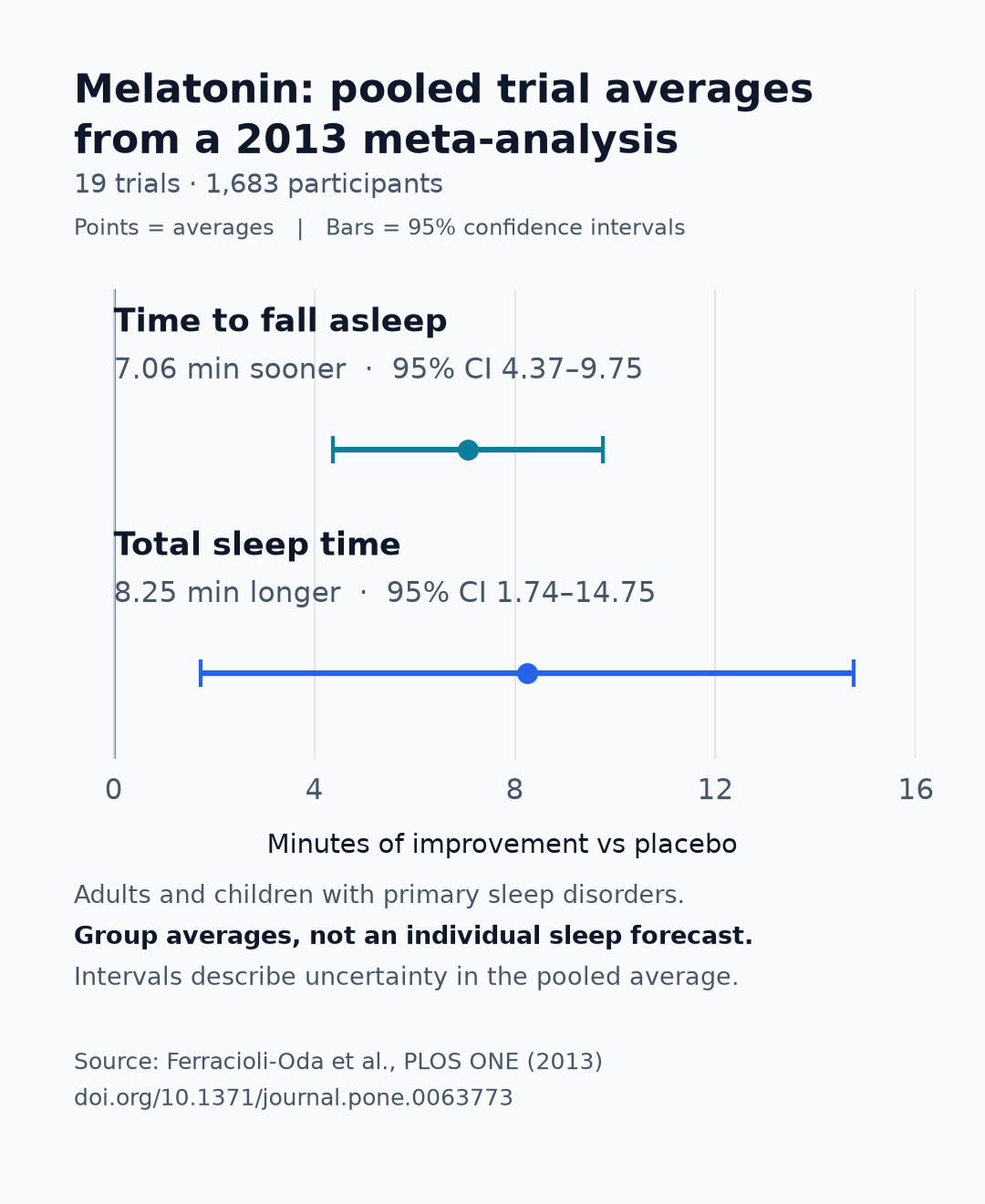
Those confidence intervals describe uncertainty around the estimated pooled effects. They aren't a range of results that individual people should expect, and they don't mean that most users will gain between two and fifteen minutes of sleep.
The trials included different populations, treatments and ways of measuring sleep. A statistically significant average doesn't establish that every study found the same result or that every participant benefited.
The analysis also reported an improvement in sleep quality, measured as a standardized mean difference of 0.22. That's a statistical measure used to combine results across scales. It does not mean sleep quality improved by 22 percent, and it can't be translated into points on your tracker.
There are limits to applying this paper to yourself. It included adults and children, and the authors could not adequately examine differences between those age groups because there were too few pediatric trials. Its search covered studies published through March 2012. It's useful historical evidence, not a complete account of current research or a study of healthy people trying to maximize an app score.
Your tracker is answering a different question
A trial compares outcomes under a defined research protocol. Your app reports information from a particular device and its software. Before treating those as interchangeable, you'd need to know what that device measures and how its estimates were validated.
In a 2018 position statement, the American Academy of Sleep Medicine said that consumer sleep technology lacking appropriate validation could not be used to diagnose or treat sleep disorders. It also recognized that device data could contribute to a conversation with a clinician as part of an appropriate evaluation.
The date matters. That statement isn't a test of the ring or watch you bought this year. It doesn't establish a current accuracy ranking for devices, or tell us how many minutes of error your tracker makes. The sources used here can't answer those questions.
They do support a more careful way to use the information. Bring an interesting pattern to a clinical conversation, along with your own account of sleep and daytime functioning. A graph can help describe the concern without becoming the diagnosis.
When the number becomes the problem
A 2017 report by Baron and colleagues described three patients preoccupied with improving their wearable sleep data. The authors called this pattern "orthosomnia."
All three were spending excessive time in bed in an effort to increase the sleep duration their trackers reported. The authors suggested that this might have worsened their insomnia. In one case, a laboratory sleep study showed an elevated proportion of deep sleep, while the patient remained concerned about poor sleep reported by her device.
Three cases can't tell us how common this is. The authors also didn't know whether tracking had caused the patients' sleep problems or whether those problems had led them to start tracking.
The report included useful experiences with tracking, too. One patient credited his device with prompting an evaluation that identified severe sleep apnea. That's a reason to avoid a blanket verdict about wearables.
The concern is what happens when improving the score becomes the goal, regardless of whether the person is sleeping or functioning better.
The label adds another uncertainty
There is also the bottle itself.
A 2017 laboratory study by Erland and Saxena examined melatonin supplements purchased in Guelph, Ontario, across 16 brands. Measured melatonin content ranged from 83 percent below the labeled amount to 478 percent above it. Some products also contained serotonin.
Those findings concern the products tested in that place and period. They don't show that every supplement available today is mislabeled. They do show why a label alone can't establish exactly what was in a product used in an informal experiment.
NCCIH also notes that long-term safety information is limited and that melatonin can interact with medicines. Short-term use appears safe for most people, but that isn't a personalized safety assessment. Discussing the actual product and other medicines with a clinician is more useful than assuming that an over-the-counter supplement carries no risks.
Ask what you want to change
Before making the next supplement or tracking decision, put the concern into an ordinary sentence:
- "I can't fall asleep at the time I need to."
- "I wake repeatedly and struggle to get back to sleep."
- "I feel sleepy during the day."
- "I feel rested, but the app keeps telling me I slept badly."
Those descriptions give a clinician something more specific to investigate. Bring the device information, your account of the nights and days, and the supplement label if you use one. Ask whether the problem needs evaluation and what kind of improvement would matter.
You don't have to choose between paying attention to data and paying attention to yourself. Keep both in the conversation. The aim is to understand and improve your sleep, with enough evidence to know what the numbers can actually tell you.
Source note: This article draws on the five linked sources: NCCIH's fact sheet, a 2013 meta-analysis, two 2017 papers and a 2018 professional position statement. It's not a systematic review of current melatonin research or current wearable devices. No dosage or treatment schedule is recommended.
Related Posts
- Lifting After 40: How Close to Failure Should You Train?
- Unlock Y Combinator's AI Playbook: Step-by-Step Guide for Founders
- How to Become a Top Performer
- 9 decision frameworks and how to choose the right one
- Is the OpenAI Codex Plan Worth It at $200/Month?
- Make.com vs Zapier AI Automation: Real Cost Breakdown