Lifting After 40: How Close to Failure Should You Train?
6 min read
Imagine you're near the end of a set. The last rep was slow. You could probably do another, but you're deciding whether it's worth it. Would stopping now waste the work you've already done?
Research gives you a useful answer: you don't need to reach failure on every set to make progress. How close you get appears to matter differently for muscle size and strength. The evidence below doesn't establish a special rule that kicks in at 40. It can, however, help you make a better decision than pushing until you're exhausted because that feels like proof you worked hard.
Failure, defined without the drama
Momentary muscular failure means you can't finish the lifting part of another repetition through the prescribed range of motion while keeping the required technique. That's the definition used in a 2023 systematic review by Refalo and colleagues. Feeling uncomfortable and being unable to complete another good rep aren't interchangeable.
Reps in reserve, or RIR, estimates the distance from that point. It's the number of good repetitions you think you could still complete in the same uninterrupted set. If you write "2 RIR" in your log, you're saying, "I think I had two more." You haven't measured those missing reps. And you can't check the estimate by racking the bar, resting and trying again: now you've changed the conditions.
| RIR estimate | Estimated good reps remaining in the same uninterrupted set |
| 3 RIR | About three |
| 2 RIR | About two |
| 1 RIR | About one |
| 0 RIR | You don't expect to complete another good rep. |
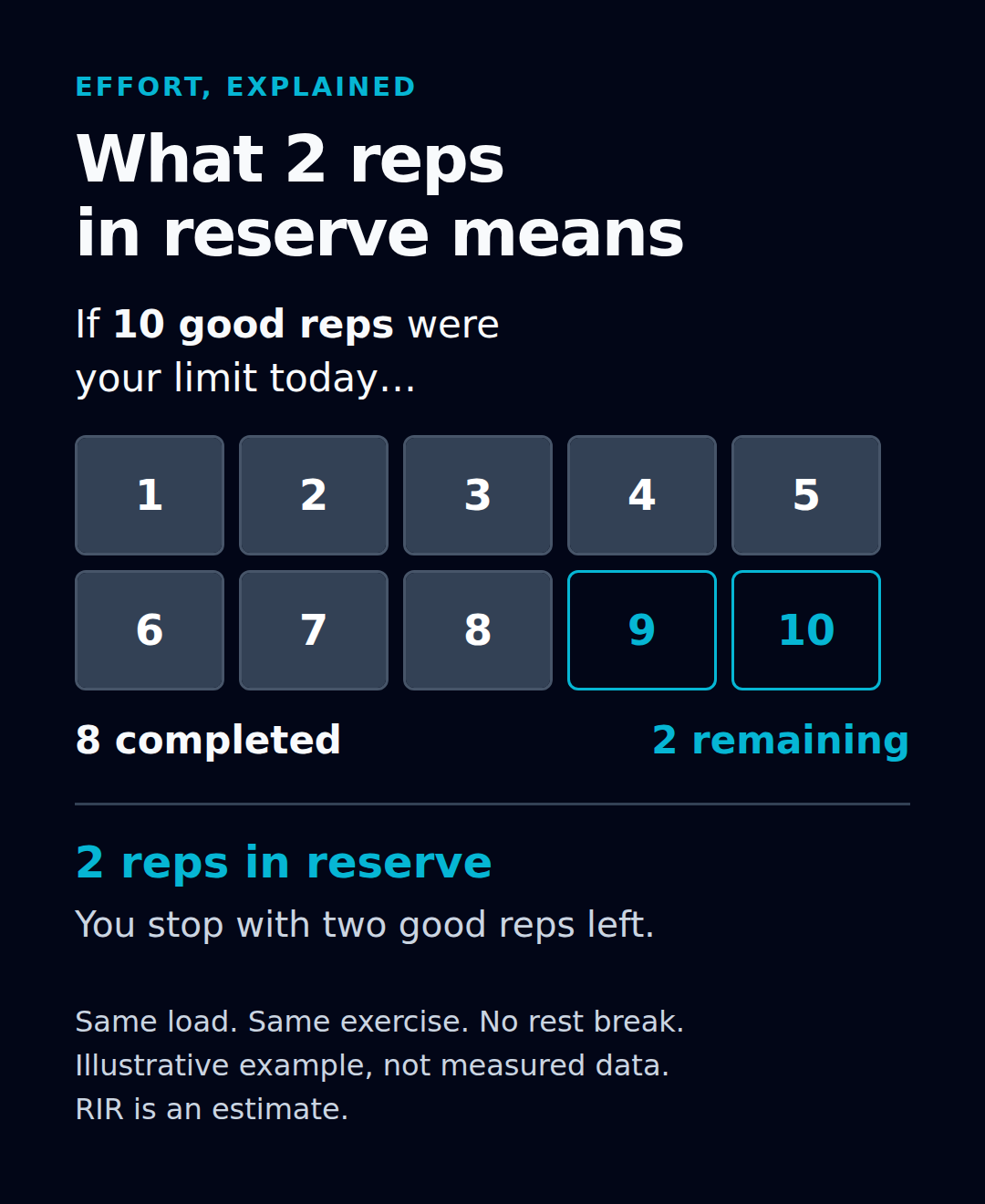
Here's a hypothetical example: if 10 good reps were your limit at today's load, stopping after eight would leave two in reserve. The illustration assumes we know that limit so the idea is easy to see. It isn't an instruction to test your maximum.
What the evidence says about stopping short
The Refalo review brought together 15 studies of muscle growth. Across studies using several definitions of "failure," it found a trivial advantage for training to failure. When the researchers looked specifically at momentary muscular failure, they didn't find convincing evidence that it produced more growth than stopping short.
That doesn't prove the two approaches are identical. Most participants were young adults, and the non-failure groups didn't all stop at the same distance from their limits. It does challenge the idea that your last possible rep is compulsory.
A 2024 trial offers a more concrete comparison. Eighteen resistance-trained adults trained twice a week for eight weeks. Each person trained one leg to failure and the other to an estimated 2 RIR on the leg press and 1 RIR on the leg extension.
The two conditions produced similar increases in measured quadriceps thickness. Going to failure caused greater losses in lifting speed and repetitions, the study's measures of acute fatigue. You shouldn't turn that into a claim about injury prevention: the trial didn't establish that. It was also small, short and limited to trained participants doing those exercises. Still, it shows that leaving a little in reserve can produce meaningful growth.
Size and strength do not answer the same way
A 2024 analysis by Robinson and colleagues looked across different estimated distances from failure. Strength gains were similar across a broad range of RIR. Muscle growth tended to be greater when sets ended closer to failure.
The researchers estimated RIR from the studies' descriptions rather than measuring it directly in every participant. They described their analysis as exploratory, and their models only partly explained the variation in results. We don't get a precise best number from it.
Read alongside the earlier review, the practical distinction is useful: "you don't need to fail" doesn't mean "effort doesn't matter." If muscle growth is your goal, how close you get deserves attention. If strength is your goal, the evidence gives you more room to stop short. Neither result tells you that every exercise should end at exactly the same RIR.
Why your RIR count is an estimate
Counting reps you haven't done takes judgment. A 2026 study tested whether people could improve that judgment. Twenty-six healthy, recreationally active adults completed six supervised sessions of bench press and leg press. Half were in a younger group with an average age of 33; half were in an older group averaging 67.
During a set, participants announced when they thought they had four and then two reps left. They continued that same set to failure under researcher supervision. Their estimates became more accurate across the sessions.
The study didn't detect a clear age difference, but it wasn't designed with enough statistical power to establish that the age groups were equivalent. It measured estimation accuracy, not muscle growth or injury risk. Nor does it mean you need to copy a supervised failure-testing protocol on your own.
The useful lesson is narrower: your RIR estimate can improve with practice, and you shouldn't assume it's exact on day one. Keep the meaning of a "good rep" consistent. If you shorten the movement or change technique to squeeze out more, you're no longer counting the same thing.
The over-40 part, kept honest
You might have decades of lifting behind you, or be learning the movements for the first time. "Over 40" doesn't tell a coach which situation they're looking at. And these papers don't establish a birthday at which the rules suddenly change.
For a public-health baseline, the CDC recommends muscle-strengthening activity at least twice a week, covering all major muscle groups. That's guidance for staying active, not a prescription for maximum muscle growth or a specific RIR.
If you're managing a medical condition or persistent pain, discuss your training with a clinician. For exercise selection, technique and how hard to push, a qualified coach can help you apply the evidence to your circumstances. Don't turn this article into a reason to attempt a failed squat or bench press alone.
What to record, and what to review
Write down the load, the reps and your estimated RIR for each working set. Keep technique comparable between sessions so the numbers describe the same exercise. Then read the pattern across several sessions instead of judging a single workout.
If your program says "leave two reps," record your best estimate rather than pretending you know for certain. When you review the log, ask: are you completing more comparable reps, handling more load, or feeling more confident about the effort estimate? If the answer is unclear, you've got a specific question to bring to a coach.
The 1-to-2-RIR approach in that small trial is a useful example to discuss, not a universal target. You don't need to earn permission to stop by failing the next rep. Give yourself a clear reason for how you're training, keep a record, and judge progress across sessions instead of using exhaustion as your score.
Related Posts
- Unlock Y Combinator's AI Playbook: Step-by-Step Guide for Founders
- How to Become a Top Performer
- 9 decision frameworks and how to choose the right one
- Is the OpenAI Codex Plan Worth It at $200/Month?
- Make.com vs Zapier AI Automation: Real Cost Breakdown
- 10 Strategies to Prepare your Company for Outsourcing