How Do You Know You Have Two Reps Left?
5 min read
A strength program tells you to stop with two repetitions left. You finish a set, rack the weight, and enter “2” in your workout log. What did you just record: how many reps you could have done, or how many the program told you to leave?
Those can be different numbers. My problem with advice to “train smarter” is that it skips this part. Before a target can guide your training, you need some way to recognize it. Knowing the instruction is easier than knowing whether you followed it.
The term is repetitions in reserve, usually shortened to RIR. Two RIR means you could have completed two more repetitions at the same load, through the prescribed range of motion, without changing your form. It describes the work still available when you stop. You cannot count those repetitions because you chose not to perform them.
Consider a hypothetical log entry: 60 kilograms, eight repetitions, two RIR. The weight and completed reps describe what happened. The final number describes what you think would have happened. Put them in identical boxes and that difference becomes easy to miss.
I would give those boxes different labels.
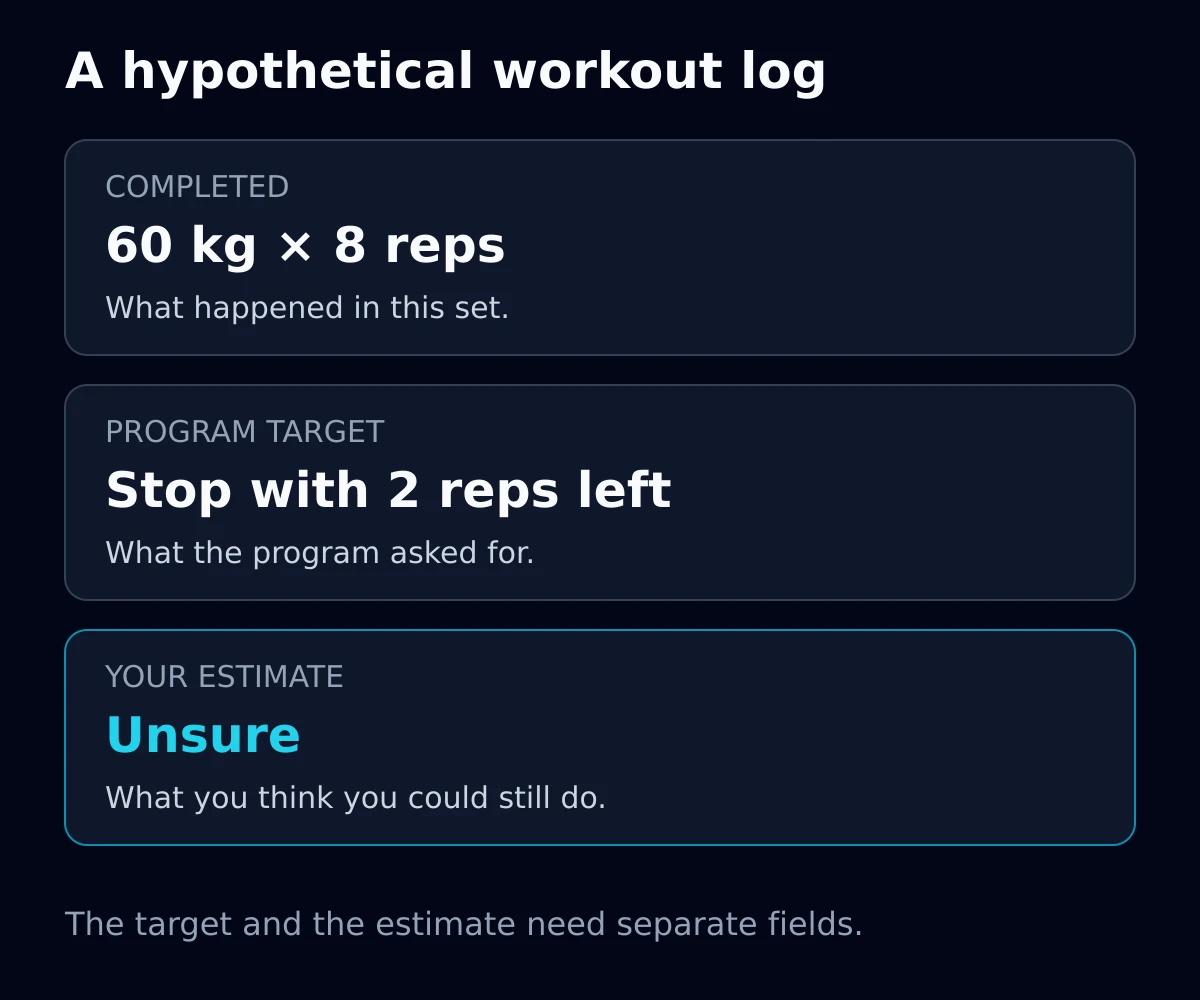
What would make the estimate better?
There is an obvious problem with learning to judge your limit: stopping short leaves you without a direct check of the estimate. Repeating “two left” in a log can make the entry consistent without making it accurate.
A 2026 study of younger and older adults made that hidden quantity observable. During supervised bench-press and leg-press sets, participants signaled when they thought they had four and then two reps remaining. They continued the same set to failure. Researchers could compare the prediction with the repetitions actually completed afterward.
Across six training sessions, the 26 participants improved their estimates. Both age groups tended to think they had fewer reps remaining than they actually did. Accuracy also depended on the exercise and the point in the set. Judging two reps remaining was more accurate than judging four.
This was a small, supervised study of estimation, not evidence that a particular logging habit builds more muscle. Nor does it turn failure testing into homework to attempt alone. What makes the setup useful to understand is the comparison: a prediction followed by an observable result, without a rest changing the task between them.
That is the missing step in “just learn how hard to push.” Experience can include feedback about a mistaken estimate. A record of the estimate alone cannot supply that feedback.
Why not take every set to failure?
That would settle the question for that set. It would also make a separate decision about how to train.
A systematic review of training proximity to failure found no demonstrated muscle-growth advantage for reaching momentary failure over stopping short in that comparison. It did not establish an ideal number of reps to leave, or show that comfortably easy sets work just as well.
There is a reason to keep that distinction. A 2024 analysis associated training closer to failure with greater muscle growth, while the relationship with strength gains was much less clear. The authors estimated proximity to failure from descriptions of the included programs and cautioned that the exact relationship remained uncertain.
So there are two questions here. What effort should this program ask for? And how well can this person judge that effort? A study about the first cannot automatically answer the second. Neither can an app that asks for a number.
A more honest workout log
I would separate the program's target from the lifter's estimate. In our hypothetical entry, the target could say “2 RIR,” while the estimate says “unsure.” That tells a coach something useful: the instruction was understood, but recognizing the stopping point still needs work. Copying the target into the estimate hides that problem.
The useful next conversation is specific: “On this exercise, what counts as a completed rep, and how can we safely check whether my estimate is close?” A qualified coach can help choose an appropriate setup and feedback method. The supervised study shows one way researchers checked estimates; it does not prescribe the right test for every exercise or lifter.
Until there is a basis for confidence, I would rather see uncertainty recorded honestly than precision supplied by a dropdown menu. Eight completed reps is a count. Two reps left is a prediction. A good training tool should help you learn the difference before treating both as facts.